
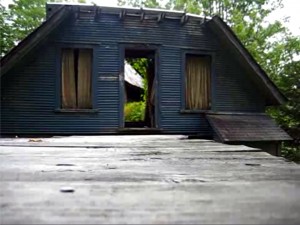
Exterior of Nina’s house, from a video by Ryan Barber
Nina practiced “the art of dying.” She had started dying many years before I met her, even if her body didn’t manage it until 2002. She saw it as Alan Watts did: “Dying is an art. It’s also an adventure.”
One example was that, during the time I knew her, she began dismantling her house.
Each time I visited, less and less of it remained. It was a small Vermont farmhouse, surrounded by trees because the forest had grown up in the 150 years since it had been built. It was cold and drafty at best, yet Nina had begun removing the outer walls, leaving the rooms open to the outdoors in all seasons. Where necessary, she stacked bales of hay to hold up the roof. She stripped the interior walls of their lath and plaster to reveal the raw boards inside.
You can get a rough sense of it from a video at https://myspace.com/180683135/videos. I have not been there in 25 years, but the shingled, curved roof on the exterior front of the house is a relatively recent addition; the interior is the old farmhouse, its inner walls stripped, outer walls opened to the encroaching forest.
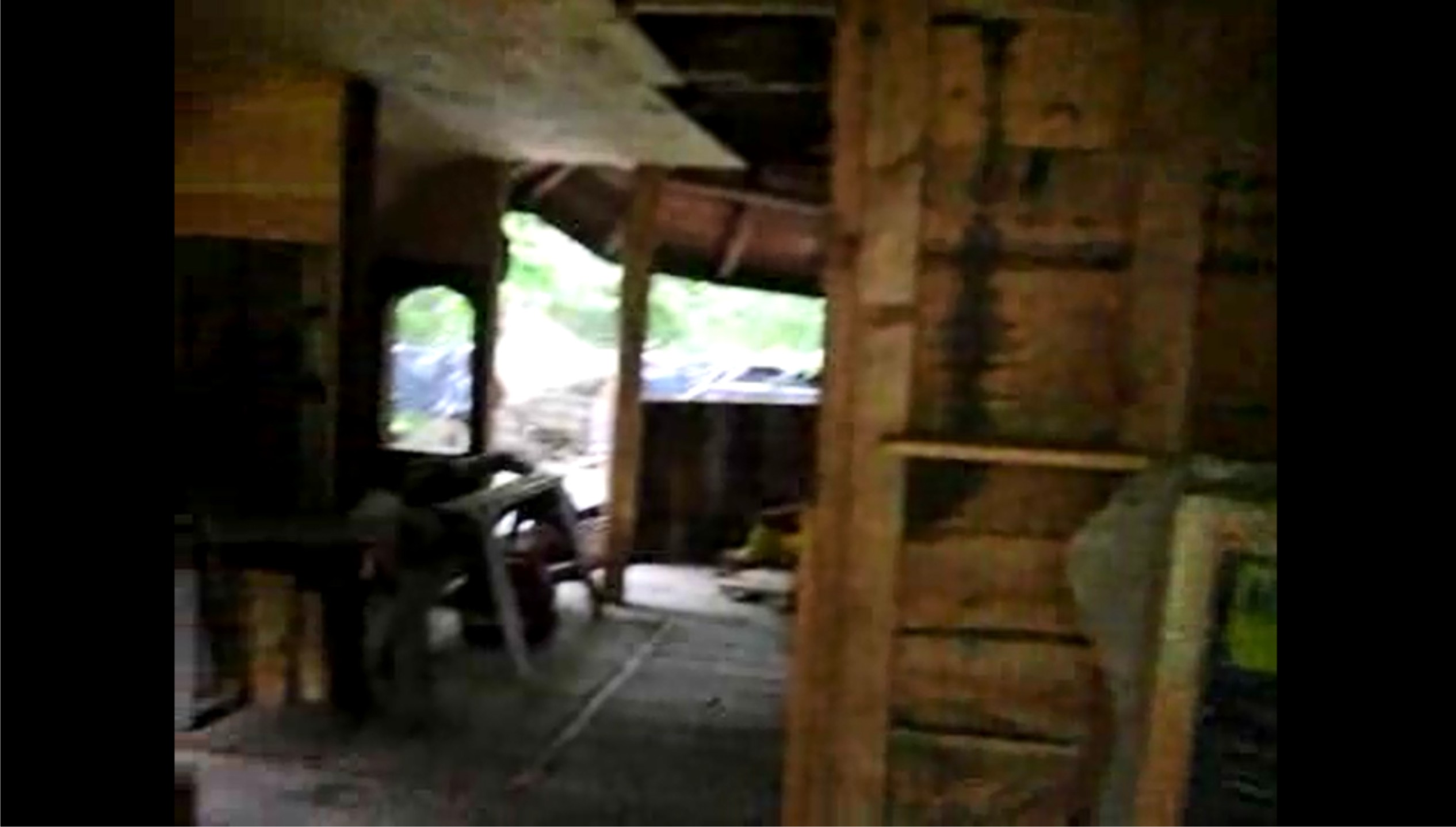
Interior of Nina’s house — thanks again to Ryan Barber
She was dismantling her physical existence.
Such activities could be seen as the work of a highly eccentric, perhaps unbalanced person. But no one who knew Nina — the clarity and poetry of her speech, her poised physical presence, the perfectly-articulated logic of her metaphysical discourse — could consider her anything but supremely balanced.
Similarly, my preceding posts make Nina sound like a crabby and intolerant person. But she wasn’t, and our visits spanned many moods.
She could laugh like no one else. For example, there was a period when several young people came to me seeking to learn shamanistic practices. I was egocentric enough to encourage them — and, in fact, the magical gift did sometimes come to us during our woods walks; we sometimes experienced truly rare and miraculous events. In any case, I brought one young man, a student at Goddard College, to see Nina as part of his magical education.
B.L. was very young — intelligent, cheerful, clumsy, open-faced, naive. His nose always seemed to be running, and despite my efforts to teach him to walk in balance and silence, he’d stumble around, even in winter, trailing his untied shoe laces behind him. His curiosity and open-mindedness commended him even if his aptitude did not.
When I explained the purpose of our visit, sitting on the floor across from Nina, she inspected him briefly and then exploded with laughter. I did too. It was gut-clenchingly funny, and she almost fell over; I think I actually did. I saw the scene through her eyes: here’s this completely undisciplined, clownish kid aspiring to become a shaman. And, talk about the blind leading the blind, here’s Daniel, a completely undisciplined clownish kid with the hubris to play teacher!
It was hilarious, an absolute hoot. We absolutely cracked up. Poor B.L. didn’t know what came over us.
Another visit: For several years, I carried with me a special black stone that I had found in the surf at Big Sur. It was an irregularly roundish, smooth black stone about the size of a half-dollar, about a quarter inch thick, and over the years I’d rubbed it with my thumb and oiled it on my nose until it had a satiny glow. More than a good-luck charm, it was for me a kind of psychic battery, a repository for energy that I imparted to it over time and that I could, when needed, draw energy from.
At some point, after coming back from another California trip, I decided it had served me long enough and that I’d give it to Nina. As always, I sat across from her on the floor in the band of light from the window. She was cheerful and glad to see me. I told her I had a present for her and handed her the stone.
Her face lit up when she saw it. “I have a place just for it!” she exclaimed.
Since I’d last visited her, she had been making a mosaic on her floor, imbedding many small stones and tiles in cement. She laid my stone into a gap in the design — where it fit perfectly. She was radiantly happy at the gift: at the magic that had made her leave that one space open, that had led me to find just that stone at Big Sur all those years before, and to present it to her at just that moment.
One final, crucial memory: I had always been repelled by the way her followers treated her — such deference, such hushed self-effacement, such an exalted, perverted perspective on Nina’s physical self. Once, when Nina had badly cut her ankle, one of her acolytes explained to me that it wasn’t really a physical injury, but a psychic one — a spiritual injury, something I wouldn’t really understand.
“Hey,” I told her, “all damned injuries to anyone are spiritual injuries.” I had recently wrecked my knees during some free-running acrobatics, and the absence of my usual mobility was a genuine, painful impediment to my way of living, to my practice. “Trust me, a man who breaks his leg and can’t go to work to earn money to feed his kids — that’s a spiritual injury, too!” I told her. “Everyone’s body is an avatar. Your idea that there’s a spiritual hierarchy, with higher and lower beings, is self-serving bullshit.”
I was furious with Nina’s followers for what I saw as their dehumanizing treatment of her. They could not construe anything she did or that befell her as simply a part of a human woman’s life experience. It was always something “beyond,” “more important” than the “mere” human experience. In this, and in their failure to challenge her egotism — demonstrated by her outrage at my introductory somersault — I felt they robbed her of experiences that would allow her to grow into her full personhood.
This I refused to do, and I believe Nina appreciated my refusal.
Once, during one of our walks in the woods behind the house, the two of us wandered for a bit and then hesitated at a fork in the path.
“Look,” I said. “Two paths!” She knew what I meant: There is no single way, there is no need for all to take one path. They all wander through the beautiful woods.
She gazed at me and rather sadly said — I wish I could remember her exact words! — “I am so glad you are here to remind me what I really am. Too few of the people around me have the courage.”
Then she took one path, and I, determined to always challenge her, took the other. Of course, as paths will, the two strands reunited only a few yards farther on.

I was searching online to find the name of the ashram. I used to live in the community with my family, although we are Christians, and do not follow the path. We were staying with various people who belong to the ashram, first wth Tenessee Steve and his wife (maybe her name was Nancy). They had a new baby at the time, 1980 I believe.. We used to live on a commune with Tenessee Steve, but it was not The Farm, it may have been Earth People’s Park in Norton, VT. or another commune we lived at in West Virginia, years earlier. We had become homeless, a family of 5. We were always moving from place to place, livng on the land when settled, or a commune, or crashing with friends at their apartments, or sometimes having an apartment of our own. Anyhow we stayed with several people and families who were on the path, including staying in the house where everybody met for Satsang on Saturday, with a lady who had many cats (maybe Marianne). Jim Kelsoe and his wife Jean lived there too I think, and Jim’s son Shamus. Greta and Trever Lowther’s father, Bruce lived on that same property in a small round house. We stayed with other families too. Marion and Carol Anderson, The Burke’s with Peter and Sally (aka Tara), Samatha, Claudia and Michael. We rented a cabin for a couple years on Cranberry Meadow Pond. All the most kind friends and in Calais, my favorite place in the whole world (so far). Rick Silberman’s wife Judy, gave my mother cooking lessons, since she was new to a vegetarian diet. we loved visiting at their home and playing with their children, Aviva, Zia, Mirabai, and baby Sarah at that time. We would go on nature walks and forage for wild edibles, to use in our cooking lessons. My father David Callahan (Bear), would sometimes talk about spiritual beliefs and differences with the other adults. My brother was 11, I was 9, and my sister was 7. Dad would sometimes take us to go visit Nina. Her home was very beautiful. I loved the slate stone work on the floor and fireplace, the wooden beams reaching up, so sturdy, and really the peaceful nature of her home. She always had a nice layer of clean pine needles on the floor. It was like a rug to keep your feet warm, and I loved that. Nina was a very beautiful person. I always thought I would want a long white braid like hers when I grew up, and cotton white gowns. She had soft round meditation cushions, and you did not have to meditate to sit on them. She may have had some seiza benches too, which Rick Silberman made in his wood shop. People could use them to sit in a knealin position, or to meditate. They took the presure off of your ankles and knees. Nina always was very gentle, kind and interesting with our conversations. She had a delicious treat that she loved to share: a special kind of rice candy, it was all natural, and it was soft and chewey like taffy. I liked the open front area of her house, sometimes racoons and even porcupines could wander right into the house. I thought it was kind of brave of her to not be scared of wild animals, especially porcupines or skunks. I thought she was like cinderella, where the wild woodland creatures knew that she would not harm them, so they enjoyed eachothers company and did not intrude on eachothers space (not that I ever noticed). There was a man named Billy, who worked on the property and helped with construction, cleaning up the house, gardening etc. He wore a turban. I think he also may have worked at the Hunger Mountain Food Coop in Montpelier. There were times when we did not have food, that he would give my mother fruits and vegetables that the coop had discarded. They had spots and what have you, but if there was not much rot, you could cut it off and use the rest. I thought that was a kind thought, even though sometimes we ended up composting most of it. I did not 100% understand why my father would want to have talks with Nina about spiritual beliefs when they had opposing views. It may have been curiousity, my father wanting to glean insight into her beliefs and values. But to what end, what was his motivation, I knew he would not change his beliefs and our family was not going to join the path in a spiritual sense. There were some tense momments, when they would disagree on something, but I saw that she was strong, and Bear was not going to change her mind on her beliefs or
show authority over her, in her own home and community. Even though I did not share the same beliefs with Nina, I admired that she was not feeding into my dad’s ego. I guess, I just wanted to say all this stuff that came to mind, when I read your aticle. You stirred up a lot of memories about Nina from my childhood, so thank you for getting me thinking, it is nice to remember good times. Be blessed.